
29.25 CDR-Approved CPEUs I CDR Activity Number: 192090
Advanced Certificate in Long-Term Care Survey & Regulatory Compliance
An in-depth, self-paced course designed to help Registered Dietitians better understand survey expectations, strengthen documentation, and apply regulatory knowledge in real-world LTC settings.
Enroll in the Certificate Program29.25 CDR-Approved CPEUs I CDR Activity Number: 192090
Advanced Certificate in Long-Term Care Survey & Regulatory Compliance
An in-depth, self-paced course designed to help Registered Dietitians better understand survey expectations, strengthen documentation, and apply regulatory knowledge in real-world LTC settings.
Enroll in the Certificate Program.......
Are you a Registered Dietitian working in long-term care but unsure if you are fully prepared for state survey?
Many dietitians working in long-term care receive little to no formal training in CMS regulations, survey expectations, and nutrition-related F-Tags. This can lead to documentation errors, survey deficiencies, and unnecessary stress during regulatory inspections.
This certificate program provides the regulatory knowledge, practical tools, and real-world case studies needed to confidently navigate survey expectations and maintain compliance in long-term care settings.
Created by a fellow RD and former State Surveyor with 25+ years of long-term care experience, this certificate program provides practical strategies you can immediately apply in your facility.
This program is the most comprehensive regulatory training available for LTC dietitians.
.......
Are you a Registered Dietitian working in long-term care but unsure if you are fully prepared for state survey?
Many dietitians working in long-term care receive little to no formal training in CMS regulations, survey expectations, and nutrition-related F-Tags. This can lead to documentation errors, survey deficiencies, and unnecessary stress during regulatory inspections.
This certificate program provides the regulatory knowledge, practical tools, and real-world case studies needed to confidently navigate survey expectations and maintain compliance in long-term care settings.
Created by a fellow RD and former State Surveyor with 25+ years of long-term care experience, this certificate program provides practical strategies you can immediately apply in your facility.
This program is the most comprehensive regulatory training available for LTC dietitians.
Start Here
Watch this short video to learn how to navigate survey expectations with confidence
Discover how long-term care dietitians can improve survey readiness, strengthen documentation, and better understand federal and state survey requirements.
Start Here
Watch this short video to learn how to navigate survey expectations with confidence
Discover how long-term care dietitians can improve survey readiness, strengthen documentation, and better understand federal and state survey requirements.

You're A Good RDN but...

You don't feel confident in your role as a Long Term Care RD
You're unsure of the regulations and concerned about whether you're doing everything required
Your facility is in its survey window and you're feeling nervous
When you hear the words "State is in the building" you hope you've done everything you needed to and that they don't ask to speak with you
You have strong clinical skills but aren't fully familiar with LTC regulatory terminology
You're A Good RDN but...
You don't feel confident in your role as a Long Term Care RD
You're unsure of the regulations and concerned about whether you're doing everything required
Your facility is in its survey window and you're feeling nervous
When you hear the words "State is in the building" you hope you've done everything you needed to and that they don't ask to speak with you
You have strong clinical skills but aren't fully familiar with LTC regulatory terminology
Get Started
After Completing This Certificate Program...
You will be well equipped and feel confident in your role as the nutrition expert in LTC.
This course is unlike any other training available for long-term care dietitians. It contains videos, written modules, downloads, PDFs, templates, AND real-world experience from my 25+ years of experience in LTC having conducted, and also having successfully passed, 100s of surveys.
This is not strictly a MDS or care planning course; however, The MDS Guidelines & Coding criteria are included.

Get Started
After Completing This Certificate Program...
You will be well equipped and feel confident in your role as the nutrition expert in LTC.
This course is unlike any other training available for long-term care dietitians. It contains videos, written modules, downloads, PDFs, templates, AND real-world experience from my 25+ years of experience in LTC having conducted, and also having successfully passed, 100s of surveys.
This is not strictly a MDS or care planning course; however, The MDS Guidelines & Coding criteria are included.
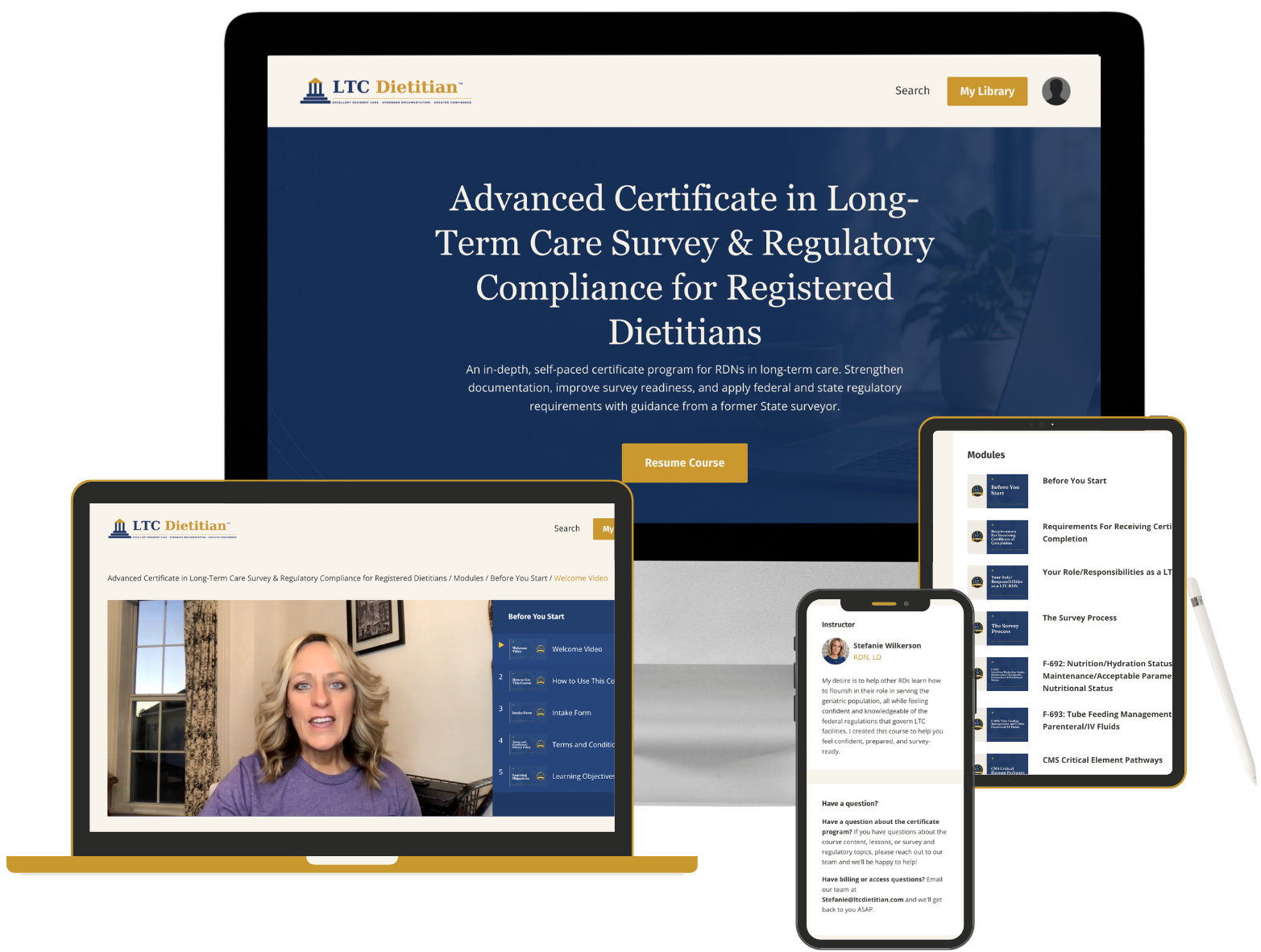
Your Roadmap To Being Survey Ready
-
Before You Start
5 lessons- Welcome Video
- How to Use This Course
- Intake Form
- Terms and Conditions/Privacy Policy
- Learning Objectives
-
Requirements For Receiving Certificate of Completion
1 lesson- Information on Summative Assessment/Final Examination
-
Your Role/Responsibilities as a LTC RDN
12 lessons- Video On Role & Responsibilities
- Characteristics Needed For A RDN In LTC
- Employee vs. Consultant
- Information/Documents The Facility Will Need For Your File
- What Are The Requirements Of The RDN In LTC
- State Law Requirements: TAC Requirement For Example
- How to Find Your State’s Specific LTC Nutrition Regulations
- State Regulations Worksheet
- What Role/Responsibilities Does the RDN Have in LTC
- Key Points To Address
- Organizational System
- Sample RDN Consultant Contract
-
The Survey Process
14 lessons- Video on the Survey Process
- The Purpose of a Survey
- Survey Protocol
- What is an F Tag and A Statement of Deficiency?
- List of F Tags
- Scope and Severity Grid for F Tags
- What Does the RD Need to Be Aware of During the Survey Process?
- Understanding the CMS State Operations Manual (SOM) in Long-Term Care
- State Operations Manual Guidance To Surveyors: Appendix PP_Release_Nov 22
- Staying Current With CMS & State Regulatory Updates
- The CFR vs SOM vs Appendix P vs Appendix PP
- Long Term Care Survey Process (LTCSP) Procedure Guide Introduction
- Long Term Care Survey Process (LTCSP) Procedure Guide
- Module Quiz: The Survey Process
-
F-692: Nutrition/Hydration Status Maintenance/Acceptable Parameters of Nutritional Status
13 lessons- Video Part 1 of F 692
- Intent and Definitions
- Guidance
- Assessment
- Care Planning
- Interventions
- Monitoring
- Let's Walk Through This Part Together/Your Roadmap To Be Ready For State
- Video Part 2 of F 692
- Investigative Protocol and Key Elements of Noncompliance
- Examples of Noncompliance and Their Severity Levels (This is golden information!)
- Specific Deficiencies I Have Written
- Module Quiz
-
F-693: Tube Feeding Management and F-694: Parenteral/IV Fluids
20 lessons- Video On Assisted Nutrition And Hydration
- Intent And Definitions
- Guidance and Considerations Regarding the Use of Feeding Tubes
- Consent For Feeding Tube
- Technical Aspects of Feeding Tubes
- Nutritional Aspects of Feeding Tubes
- Complications
- Procedures And Use of The Tube Feeding Critical Element Pathway
- Key Elements of Noncompliance/A Deficiency Will Be Written When the Following Does Not Happen
- Severity Level 4 Noncompliance : Immediate Jeopardy To Resident Health Or Safety
- Severity Level 3 Considerations: Actual Harm that is Not Immediate Jeopardy
- Severity Level 2 Noncompliance: No Actual Harm With Potential for More Than Minimal Harm that is Not Immediate Jeopardy
- Severity Level 1: No Actual Harm With Potential For Minimal Harm
- Specific Deficiencies I Have Written
- F-694: Parenteral Fluids Intent and Definitions
- Guidance For Parenteral Fluids
- Complications/Risks of Intravenous Fluid Administration
- Investigative Procedures
- Deficiencies of Categorization
- Module Quiz
-
CMS Critical Element Pathways
15 lessons- Video On Critical Element Pathways
- What Are CMS Critical Element Pathways?
- CMS-Nutrition
- Let's Walk Through This Together From the RD Lense
- CMS-Dental
- Let's Walk Through This Together From the RD Lense
- CMS-Pressure Ulcer
- Let's Walk Through This Together
- CMS-Tube Feeding
- Let's Walk Through This Together
- CMS-Hydration
- Let's Walk Through This Together
- CMS-Dialysis
- CMS-Hospice and End of Life
- Module Quiz
-
Tips On Interacting With Surveyors
5 lessons- Video On Tips With Interacting With Surveyors
- 5 Do's Of Communicating With Surveyors
- 5 Don'ts Of Communicating With Surveyors
- Bonus Tip
- What To Do When They Ask, "What Is Your Policy?"
-
The Kitchen Sanitation Inspection
9 lessons- Video On Kitchen Sanitation
- How Often Should A Kitchen Inspection By Completed
- Appropriate Attire For Completing Inspection
- Key Items To Look For During The Kitchen Inspection Per CMS
- Other Important Items to Monitor
- Communication
- CMS Kitchen/Food Service Observation Form
- CMS HHS KITCHEN/FOOD SERVICE OBSERVATION DETAILED REPORT
- Module Quiz
-
F-812: Food Safety, Sanitation, and Infection Control in Food Service
9 lessons- Video On Food Safety
- Food Safety Requirements
- Examples of Level 4: Immediate Jeopardy To Resident Health And Safety
- Example Of Level 3: Actual Harm (Physical Or Psychological) That Is Not Immediate Jeopardy
- Examples Of Level 2 : No Actual Harm With A Potential For More Than Minimal Harm (Physical Or Psychological) That Is Not Immediate Jeopardy
- Level 1 Severity
- Additional Concerns
- Specific Deficiencies I Have Written
- Module Quiz
-
Trayline Observations
5 lessons- Video On Trayline Observations
- Frequency And Key Things To Observe During Trayline Observations
- Concerns I Have Observed With Pureed Foods
- Test Trays
- Tray Audit Form
-
Dining Room Observations and F-803 to F-809
10 lessons- Video On Dining Room Observations
- What Are Surveyors Looking For During Dining Observations
- CMS-20053 Dining Observation Form
- If Concerns Are Noted Surveyors Next Steps Will Be The Following (Don't Miss This)
- F803-F809
- DEFICIENCY CATEGORIZATION: Examples Of Level 4, Immediate Jeopardy to Resident Health and Safety
- Example Of Level 3: Actual Harm (Physical or Psychological) That Is Not Immediate Jeopardy
- Examples Of Level 2 : No Actual Harm With a Potential For More Than Minimal Harm (Physical or Psychological) That Is Not Immediate Jeopardy
- Example Of Level 1: No Actual Harm With a Potential For Minimal Harm
- Module Quiz
-
Clinical Charting/Reports/Guidelines
18 lessons- Video Part 1 Clinical Charting Requirements
- Minimum Number of Hours Required By RDN
- Which Residents Should You Chart On & When
- The Method I Use For Tracking
- Chart for Determination of Significant or Severe Weight Loss
- Formula To Determine % of Body Weight Lost
- Video Part 2 Clinical Charting
- Three Keywords To Document When Charting/What Are Surveyors Looking For
- Best Practice Documentation Guidelines For Consulting Dietitians
- Example of Unintended Weight Loss Protocol and Case Study
- Sample Nutrition Assessment Form
- Calculation of Nutrient Needs
- Dietitian Visit Report
- Monthly Weight Loss Report
- Monthly Weight Gain Report
- Nutrition Recommendations Report
- MD Letter
- Module Quiz
-
Best Practice Guidelines: Examples
13 lessons- Video On Best Practice Guidelines
- Best Practice State Guidelines
- Best Practice Dining/Meal Service
- Best Practice Unintended Weight Loss
- Example Care Plan for Unintended Weight Loss
- Best Practice Unintended Weight Gain
- Best Practice Intended Weight Loss
- Best Practices in Nutrition Care at End-of-Life
- Best Practice Documentation Guidelines For Consulting Dietitians
- Healthy Hydration Evidence-Based Best Practices
- Registered Dietitian’s Role Evidence-Based Best Practices
- Pressure Injury Prevention & Management Evidence-Based Best Practices
- Module Quiz
-
MDS/Care Plans
7 lessons- Video On MDS/Care Plans
- Who Is Responsible
- MDS-3.0-Chapter-3-Section-K Guidelines/Coding
- Common Coding Errors in Section K
- Care Plans/Interdisciplinary Team
- Dietitian-Specific Compliance Guide for LTC
- Module Quiz
-
FAQ
9 lessons- Video On FAQs
- Resident Refusing To Be Weighed
- Can The RDN Write Diet Orders?
- What Are The Requirements For the Director of Food Service
- Can A Deficiency Be Written For Substituting Food Items & Not Updating The Menu or Notifying Residents?
- Does CMS Allow for Staff Exemptions from the COVID Vaccine?
- Can A Visitor Share a Meal With or Feed The Resident They Are Visiting?
- Position Statement On Liberalized Diets
- Can outside food be brought in for a resident?
-
Conclusion & Next Steps
2 lessons- Let's Keep It Simple
- Keeping Things in Perspective
-
CEU
2 lessons- Performance Indicators
- Certificate
-
Final Examination
2 lessons- Final Examination Eligibility & Acknowledgment
- FINAL EXAMINATION
-
Course Evaluation
1 lesson- Course Evaluation
-
Advanced Certificate
1 lesson- Certificate of Completion
-
Bibliography
1 lesson- Bibliography
Your Roadmap To Being Survey Ready
-
Before You Start
5 lessons- Welcome Video
- How to Use This Course
- Intake Form
- Terms and Conditions/Privacy Policy
- Learning Objectives
-
Requirements For Receiving Certificate of Completion
1 lesson- Information on Summative Assessment/Final Examination
-
Your Role/Responsibilities as a LTC RDN
12 lessons- Video On Role & Responsibilities
- Characteristics Needed For A RDN In LTC
- Employee vs. Consultant
- Information/Documents The Facility Will Need For Your File
- What Are The Requirements Of The RDN In LTC
- State Law Requirements: TAC Requirement For Example
- How to Find Your State’s Specific LTC Nutrition Regulations
- State Regulations Worksheet
- What Role/Responsibilities Does the RDN Have in LTC
- Key Points To Address
- Organizational System
- Sample RDN Consultant Contract
-
The Survey Process
14 lessons- Video on the Survey Process
- The Purpose of a Survey
- Survey Protocol
- What is an F Tag and A Statement of Deficiency?
- List of F Tags
- Scope and Severity Grid for F Tags
- What Does the RD Need to Be Aware of During the Survey Process?
- Understanding the CMS State Operations Manual (SOM) in Long-Term Care
- State Operations Manual Guidance To Surveyors: Appendix PP_Release_Nov 22
- Staying Current With CMS & State Regulatory Updates
- The CFR vs SOM vs Appendix P vs Appendix PP
- Long Term Care Survey Process (LTCSP) Procedure Guide Introduction
- Long Term Care Survey Process (LTCSP) Procedure Guide
- Module Quiz: The Survey Process
-
F-692: Nutrition/Hydration Status Maintenance/Acceptable Parameters of Nutritional Status
13 lessons- Video Part 1 of F 692
- Intent and Definitions
- Guidance
- Assessment
- Care Planning
- Interventions
- Monitoring
- Let's Walk Through This Part Together/Your Roadmap To Be Ready For State
- Video Part 2 of F 692
- Investigative Protocol and Key Elements of Noncompliance
- Examples of Noncompliance and Their Severity Levels (This is golden information!)
- Specific Deficiencies I Have Written
- Module Quiz
-
F-693: Tube Feeding Management and F-694: Parenteral/IV Fluids
20 lessons- Video On Assisted Nutrition And Hydration
- Intent And Definitions
- Guidance and Considerations Regarding the Use of Feeding Tubes
- Consent For Feeding Tube
- Technical Aspects of Feeding Tubes
- Nutritional Aspects of Feeding Tubes
- Complications
- Procedures And Use of The Tube Feeding Critical Element Pathway
- Key Elements of Noncompliance/A Deficiency Will Be Written When the Following Does Not Happen
- Severity Level 4 Noncompliance : Immediate Jeopardy To Resident Health Or Safety
- Severity Level 3 Considerations: Actual Harm that is Not Immediate Jeopardy
- Severity Level 2 Noncompliance: No Actual Harm With Potential for More Than Minimal Harm that is Not Immediate Jeopardy
- Severity Level 1: No Actual Harm With Potential For Minimal Harm
- Specific Deficiencies I Have Written
- F-694: Parenteral Fluids Intent and Definitions
- Guidance For Parenteral Fluids
- Complications/Risks of Intravenous Fluid Administration
- Investigative Procedures
- Deficiencies of Categorization
- Module Quiz
-
CMS Critical Element Pathways
15 lessons- Video On Critical Element Pathways
- What Are CMS Critical Element Pathways?
- CMS-Nutrition
- Let's Walk Through This Together From the RD Lense
- CMS-Dental
- Let's Walk Through This Together From the RD Lense
- CMS-Pressure Ulcer
- Let's Walk Through This Together
- CMS-Tube Feeding
- Let's Walk Through This Together
- CMS-Hydration
- Let's Walk Through This Together
- CMS-Dialysis
- CMS-Hospice and End of Life
- Module Quiz
-
Tips On Interacting With Surveyors
5 lessons- Video On Tips With Interacting With Surveyors
- 5 Do's Of Communicating With Surveyors
- 5 Don'ts Of Communicating With Surveyors
- Bonus Tip
- What To Do When They Ask, "What Is Your Policy?"
-
The Kitchen Sanitation Inspection
9 lessons- Video On Kitchen Sanitation
- How Often Should A Kitchen Inspection By Completed
- Appropriate Attire For Completing Inspection
- Key Items To Look For During The Kitchen Inspection Per CMS
- Other Important Items to Monitor
- Communication
- CMS Kitchen/Food Service Observation Form
- CMS HHS KITCHEN/FOOD SERVICE OBSERVATION DETAILED REPORT
- Module Quiz
-
F-812: Food Safety, Sanitation, and Infection Control in Food Service
9 lessons- Video On Food Safety
- Food Safety Requirements
- Examples of Level 4: Immediate Jeopardy To Resident Health And Safety
- Example Of Level 3: Actual Harm (Physical Or Psychological) That Is Not Immediate Jeopardy
- Examples Of Level 2 : No Actual Harm With A Potential For More Than Minimal Harm (Physical Or Psychological) That Is Not Immediate Jeopardy
- Level 1 Severity
- Additional Concerns
- Specific Deficiencies I Have Written
- Module Quiz
-
Trayline Observations
5 lessons- Video On Trayline Observations
- Frequency And Key Things To Observe During Trayline Observations
- Concerns I Have Observed With Pureed Foods
- Test Trays
- Tray Audit Form
-
Dining Room Observations and F-803 to F-809
10 lessons- Video On Dining Room Observations
- What Are Surveyors Looking For During Dining Observations
- CMS-20053 Dining Observation Form
- If Concerns Are Noted Surveyors Next Steps Will Be The Following (Don't Miss This)
- F803-F809
- DEFICIENCY CATEGORIZATION: Examples Of Level 4, Immediate Jeopardy to Resident Health and Safety
- Example Of Level 3: Actual Harm (Physical or Psychological) That Is Not Immediate Jeopardy
- Examples Of Level 2 : No Actual Harm With a Potential For More Than Minimal Harm (Physical or Psychological) That Is Not Immediate Jeopardy
- Example Of Level 1: No Actual Harm With a Potential For Minimal Harm
- Module Quiz
-
Clinical Charting/Reports/Guidelines
18 lessons- Video Part 1 Clinical Charting Requirements
- Minimum Number of Hours Required By RDN
- Which Residents Should You Chart On & When
- The Method I Use For Tracking
- Chart for Determination of Significant or Severe Weight Loss
- Formula To Determine % of Body Weight Lost
- Video Part 2 Clinical Charting
- Three Keywords To Document When Charting/What Are Surveyors Looking For
- Best Practice Documentation Guidelines For Consulting Dietitians
- Example of Unintended Weight Loss Protocol and Case Study
- Sample Nutrition Assessment Form
- Calculation of Nutrient Needs
- Dietitian Visit Report
- Monthly Weight Loss Report
- Monthly Weight Gain Report
- Nutrition Recommendations Report
- MD Letter
- Module Quiz
-
Best Practice Guidelines: Examples
13 lessons- Video On Best Practice Guidelines
- Best Practice State Guidelines
- Best Practice Dining/Meal Service
- Best Practice Unintended Weight Loss
- Example Care Plan for Unintended Weight Loss
- Best Practice Unintended Weight Gain
- Best Practice Intended Weight Loss
- Best Practices in Nutrition Care at End-of-Life
- Best Practice Documentation Guidelines For Consulting Dietitians
- Healthy Hydration Evidence-Based Best Practices
- Registered Dietitian’s Role Evidence-Based Best Practices
- Pressure Injury Prevention & Management Evidence-Based Best Practices
- Module Quiz
-
MDS/Care Plans
7 lessons- Video On MDS/Care Plans
- Who Is Responsible
- MDS-3.0-Chapter-3-Section-K Guidelines/Coding
- Common Coding Errors in Section K
- Care Plans/Interdisciplinary Team
- Dietitian-Specific Compliance Guide for LTC
- Module Quiz
-
FAQ
9 lessons- Video On FAQs
- Resident Refusing To Be Weighed
- Can The RDN Write Diet Orders?
- What Are The Requirements For the Director of Food Service
- Can A Deficiency Be Written For Substituting Food Items & Not Updating The Menu or Notifying Residents?
- Does CMS Allow for Staff Exemptions from the COVID Vaccine?
- Can A Visitor Share a Meal With or Feed The Resident They Are Visiting?
- Position Statement On Liberalized Diets
- Can outside food be brought in for a resident?
-
Conclusion & Next Steps
2 lessons- Let's Keep It Simple
- Keeping Things in Perspective
-
CEU
2 lessons- Performance Indicators
- Certificate
-
Final Examination
2 lessons- Final Examination Eligibility & Acknowledgment
- FINAL EXAMINATION
-
Course Evaluation
1 lesson- Course Evaluation
-
Advanced Certificate
1 lesson- Certificate of Completion
-
Bibliography
1 lesson- Bibliography
You've Got the Options!
PAY IN FULL OR PAYMENT PLAN
Includes 29.25 CDR-Approved Continuing Professional Education Units (CPEUs), {Advanced Certificate of Completion awarded upon passing the final examination} and Self-paced learning with 12 months of course access
You've Got the Options
PAY IN FULL OR PAYMENT PLAN
Includes 29.25 CDR-Approved Continuing Professional Education Units (CPEUs), {Advanced Certificate of Completion awarded upon passing the final examination} and Self-paced learning with 12 months of course access
Why This Course Is Different...

Former State Surveyor Insight
Learn From a Former State Surveyor This course was created by a Registered Dietitian who served as a State Surveyor, giving you a unique insider perspective on how surveys are conducted, what surveyors are looking for, and how deficiencies are identified.
I bring my 25+ years of experience in the LTC setting, both as a State Surveyor and RDN employee and consultant, into this course. I talk about my personal experiences and make the material applicable and easy to understand. I show you how to use the processes that surveyors use so you can be knowledgeable and prepared.

Real World Application
Practical Strategies You Can Use Immediately. This course goes beyond theory. You’ll learn real-world strategies that can be applied immediately in your facility to improve documentation, strengthen compliance, and confidently navigate survey expectations.

Video-Based Learning Included
This is NOT just a bunch of reading (although there is a lot of that too)!
Each module contains a video where I walk you through the materials in that section and explain the principles and manner in which to best use the downloads and material in order to successfully prepare you for surveys.
The videos are designed to break down complex regulations and make them easier to understand and apply.

Time Saving
No more countless hours searching for article after article, blog posts after blog post, and the overwhelming CMS website, trying to determine what you actually need to know to succeed as an LTC dietitian.
This course will save you tons of time and frustration as it provides you with a comprehensive course on what you NEED to know as an RDN in LTC.

Go Beyond CEUs — Earn an Advanced Certificate
Dietitians who successfully complete the course and pass the final examination will be awarded the Advanced Certificate of Completion for Long-Term Care Survey & Regulatory Compliance, demonstrating advanced knowledge in LTC survey and regulatory compliance.
Why This Course Is Different...
Former State Surveyor Insight
Learn From a Former State Surveyor This course was created by a Registered Dietitian who served as a State Surveyor, giving you a unique insider perspective on how surveys are conducted, what surveyors are looking for, and how deficiencies are identified.
I bring my 25+ years of experience in the LTC setting, both as a State Surveyor and RDN employee and consultant, into this course. I talk about my personal experiences and make the material applicable and easy to understand. I show you how to use the processes that surveyors use so you can be knowledgeable and prepared.
Real World Application
Practical Strategies You Can Use Immediately. This course goes beyond theory. You’ll learn real-world strategies that can be applied immediately in your facility to improve documentation, strengthen compliance, and confidently navigate survey expectations.
Video-Based Learning Included
This is NOT just a bunch of reading (although there is a lot of that too)!
Each module contains a video where I walk you through the materials in that section and explain the principles and manner in which to best use the downloads and material in order to successfully prepare you for surveys.
The videos are designed to break down complex regulations and make them easier to understand and apply.
Time Saving
No more countless hours searching for article after article, blog posts after blog post, and the overwhelming CMS website, trying to determine what you actually need to know to succeed as an LTC dietitian.
This course will save you tons of time and frustration as it provides you with a comprehensive course on what you NEED to know as an RDN in LTC.
Go Beyond CEUs — Earn an Advanced Certificate
Dietitians who successfully complete the course and pass the final examination will be awarded the Advanced Certificate of Completion for Long-Term Care Survey & Regulatory Compliance, demonstrating advanced knowledge in LTC survey and regulatory compliance.
.....
''I started at a LTC facility with very little prior experience in LTC and no dietitian available at the facility for training. I found this course so helpful in increasing my confidence in my role and learning what things I should be doing aside from just completing nutrition assessments. I would recommend this course to any dietitian who is new to LTC!''
.....
''This course was a great summary of what every RDN that works in long term care needs to know. I wish I had taken a course with all this information my first year of working in LTC. It covers all the important clinical and management aspects of preparing the dietary department for full book survey. This information will help any dietary team reach the ultimate goal of achieving a deficiency free survey.''
.....
''What I found most helpful was reviewing all the dietary F tags and CMS critical element Pathways. The examples of different scenarios during state survey were also helpful to illustrate common nutrition/ dietary f-tags that are given.''
.....
''The videos in each module going in depth on what was included in the module was what I found most helpful.''
.....
''This course exceeded my expectations, very informative and useful information!''
.....
''This course is a definite 10!''
.....
''I started at a LTC facility with very little prior experience in LTC and no dietitian available at the facility for training. I found this course so helpful in increasing my confidence in my role and learning what things I should be doing aside from just completing nutrition assessments. I would recommend this course to any dietitian who is new to LTC!''
.....
''This course was a great summary of what every RDN that works in long term care needs to know. I wish I had taken a course with all this information my first year of working in LTC. It covers all the important clinical and management aspects of preparing the dietary department for full book survey. This information will help any dietary team reach the ultimate goal of achieving a deficiency free survey.''
.....
''What I found most helpful was reviewing all the dietary F tags and CMS critical element Pathways. The examples of different scenarios during state survey were also helpful to illustrate common nutrition/ dietary f-tags that are given.''
.....
''The videos in each module going in depth on what was included in the module was what I found most helpful.''
.....
''This course exceeded my expectations, very informative and useful information!''
.....
''This course is a definite 10!''
About Me
Hi, my name is Stefanie Wilkerson and I am a Registered and Licensed Dietitian who has been working in LTC for over 25 years now. I started out as an employee for a large LTC facility and was serving as both the clinical RD, and the department head over all of the foodservice operations.
I left that facility to become a state surveyor. I was a Nutritionist V Surveyor for the state of Texas, and to be honest I loved my job! The only reason I left was to have more flexibility, and to be home more with my twins, who at the time were toddlers (they are now grown, my son is in the Marines and my daughter BECAME AN RD:)). When I left my state job I immediately began consulting with area facilities, and my business began to grow at a fast pace.
I have enjoyed my career in LTC and continue to serve facilities, along with the assistance from the other RDs on my team. Having worked as an employee, a surveyor, and as a consultant, I have a wealth of knowledge in the area of LTC
My desire is to help other RDs learn how to flourish in their role in serving the geriatric population, all while feeling confident and knowledgeable of the federal regulations that govern LTC facilities.
I created this course to help you feel confident, prepared, and survey-ready.

About Me
Hi, my name is Stefanie Wilkerson and I am a Registered and Licensed Dietitian who has been working in LTC for over 25 years now. I started out as an employee for a large LTC facility and was serving as both the clinical RD, and the department head over all of the foodservice operations.
I left that facility to become a state surveyor. I was a Nutritionist V Surveyor for the state of Texas, and to be honest I loved my job! The only reason I left was to have more flexibility, and to be home more with my twins, who at the time were toddlers (they are now grown, my son is in the Marines and my daughter BECAME AN RD:)). When I left my state job I immediately began consulting with area facilities, and my business began to grow at a fast pace.
I have enjoyed my career in LTC and continue to serve facilities, along with the assistance from the other RDs on my team. Having worked as an employee, a surveyor, and as a consultant, I have a wealth of knowledge in the area of LTC
My desire is to help other RDs learn how to flourish in their role in serving the geriatric population, all while feeling confident and knowledgeable of the federal regulations that govern LTC facilities.
I created this course to help you feel confident, prepared, and survey-ready.








FAQs
FAQs
How long will I have access to the course?
This is a self-paced learning program with 12 months of course access. You will move through the course at your own pace, go as fast or as slow as you like.
Are CEUs provided?
Yes. This course is approved by the Commission on Dietetic Registration (CDR) for 29.25 Continuing Professional Education Units (CPEUs)
CDR Activity Number: 192090
Dietitians who successfully complete the course and also pass the final examination will be awarded the Advanced Certificate of Completion in Long-Term Care Survey & Regulatory Compliance, demonstrating advanced knowledge in LTC survey and regulatory compliance.
What is the refund policy?
Due to the nature of the course, and given that you have full access to all of the materials when your enrollment begins, there are no refunds issued.
You've Got the Options!
PAY IN FULL OR PAYMENT PLAN
Includes 29.25 CDR-Approved Continuing Professional Education Units (CPEUs), {Advanced Certificate of Completion awarded upon passing the final examination} and Self-paced learning with 12 months of course access
You've Got the Options
PAY IN FULL OR PAYMENT PLAN
Includes 29.25 CDR-Approved Continuing Professional Education Units (CPEUs), {Advanced Certificate of Completion awarded upon passing the final examination} and Self-paced learning with 12 months of course access