
Get Immediate Access for $97
Bring the R.I.S.E. Method™ Into Your LTC Practice
A step-by-step framework to help long-term care dietitians investigate nutrition-related factors affecting pressure injury risk and healing, develop individualized interventions, strengthen clinical documentation, and support survey readiness.
GET THE R.I.S.E. METHOD™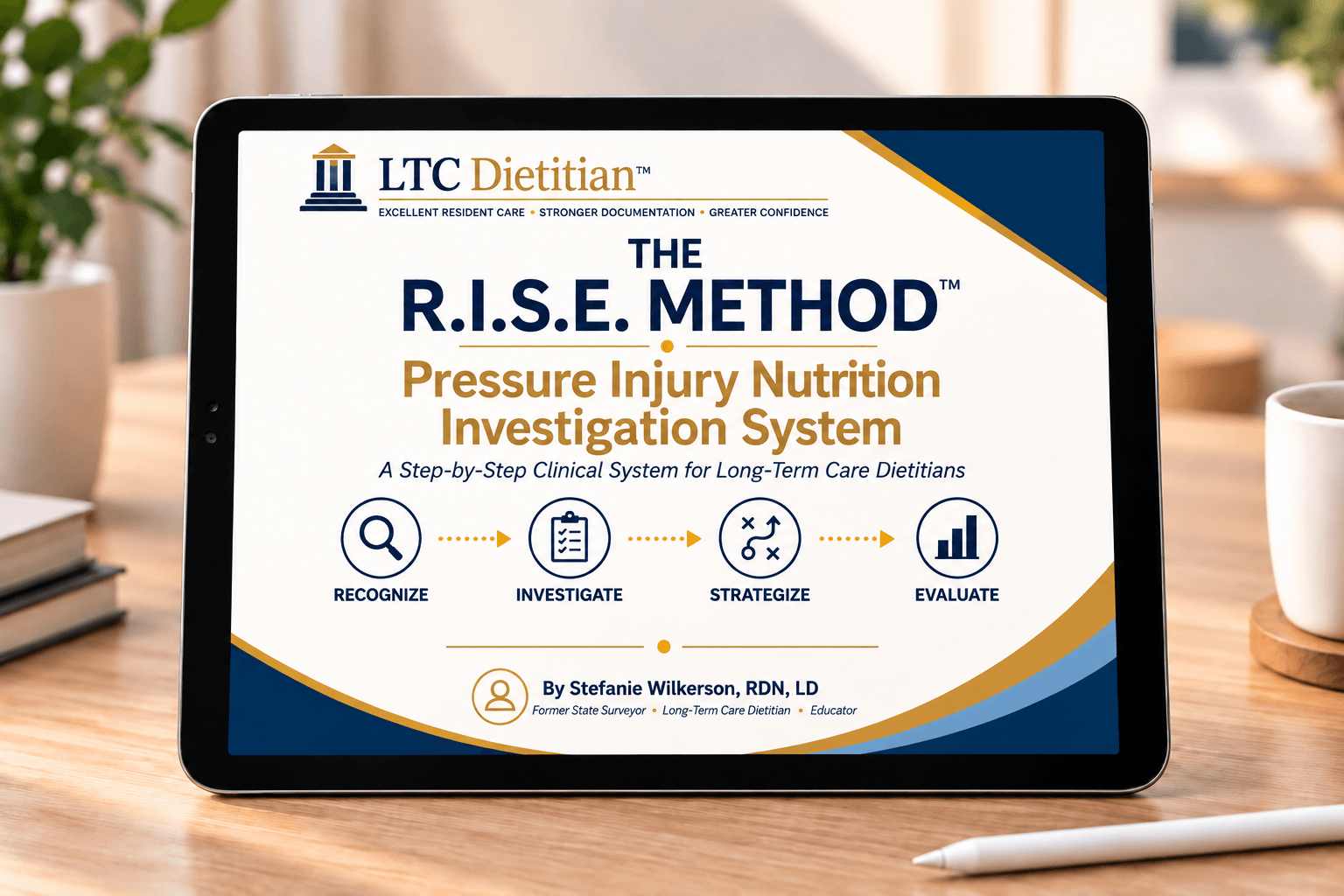
Get Immediate Access for $97
Bring the R.I.S.E. Method™ Into Your LTC Practice
A step-by-step framework to help long-term care dietitians investigate nutrition-related factors affecting pressure injury risk and healing, develop individualized interventions, strengthen clinical documentation, and support survey readiness.
GET THE R.I.S.E. METHOD™.......
When a Resident Has a Pressure Injury, “Add More Protein” Shouldn’t Be the Entire Nutrition Plan
Pressure injuries in long-term care involve far more than selecting a protein supplement or calculating estimated needs.
The dietitian must evaluate the resident’s overall nutrition status, weight and intake history, hydration, diagnoses, medications, functional limitations, food preferences, ability to adhere to the recommended plan, and other factors that may affect skin integrity and healing.
Every recommendation in this system is sourced — energy, protein, and fluid targets are drawn from the NPIAP/EPUAP/PPPIA Clinical Practice Guideline, the Academy of Nutrition and Dietetics, and peer-reviewed pressure injury nutrition literature, with unstageable wounds and deep tissue injuries specifically addressed. The common scenario of when labs aren't available, is also addressed.
The R.I.S.E. Method™ was created to give long-term care dietitians a clear, practical process for responding to pressure injuries—without relying on generic interventions, incomplete assessments, or nutrition recommendations that aren't supported by the resident's individual risk factors and clinical presentation. The R.I.S.E. Method™ guides you through four connected steps: Recognize, Investigate, Strategize, & Evaluate.
.......
When a Resident Has a Pressure Injury, “Add More Protein” Shouldn’t Be the Entire Nutrition Plan
Pressure injuries in long-term care involve far more than selecting a protein supplement or calculating estimated needs.
The dietitian must evaluate the resident’s overall nutrition status, weight and intake history, hydration, diagnoses, medications, functional limitations, food preferences, ability to adhere to the recommended plan, and other factors that may affect skin integrity and healing.
Every recommendation in this system is sourced — energy, protein, and fluid targets are drawn from the NPIAP/EPUAP/PPPIA Clinical Practice Guideline, the Academy of Nutrition and Dietetics, and peer-reviewed pressure injury nutrition literature, with unstageable wounds and deep tissue injuries specifically addressed. The common scenario of when labs aren't available, is also addressed.
The R.I.S.E. Method™ was created to give long-term care dietitians a clear, practical process for responding to pressure injuries—without relying on generic interventions, incomplete assessments, or nutrition recommendations that aren't supported by the resident's individual risk factors and clinical presentation. The R.I.S.E. Method™ guides you through four connected steps: Recognize, Investigate, Strategize, & Evaluate.
A Clear Process for Every Pressure Injury Investigation

A Clear Process for Every Weight Loss Investigation

R — Recognize
Confirm the pressure injury information available to you, review the resident’s nutrition risk, identify concerns requiring immediate attention, and determine what additional information is needed.

I — Investigate
Evaluate intake, weight history, hydration, diagnoses, medications, functional status, swallowing or feeding concerns, food preferences, labs, care delivery, and other resident-specific factors that may affect nutrition status and healing.

S — Strategize
Develop individualized nutrition interventions that directly address the findings of the investigation—not generic recommendations automatically applied to every resident with a pressure injury.

E — Evaluate
Confirm that interventions were implemented, monitor intake and tolerance, review changes in nutrition status and wound progress, and revise the nutrition plan when the resident’s needs or response change.
R — Recognize
Confirm the pressure injury information available to you, review the resident’s nutrition risk, identify concerns requiring immediate attention, and determine what additional information is needed.
I — Investigate
Evaluate intake, weight history, hydration, diagnoses, medications, functional status, swallowing or feeding concerns, food preferences, labs, care delivery, and other resident-specific factors that may affect nutrition status and healing.
S — Strategize
Develop individualized nutrition interventions that directly address the findings of the investigation—not generic recommendations automatically applied to every resident with a pressure injury.
E — Evaluate
Confirm that interventions were implemented, monitor intake and tolerance, review changes in nutrition status and wound progress, and revise the nutrition plan when the resident’s needs or response change.

Built to Help You Work More Confidently and Document More Clearly

Conduct a more complete nutrition investigation.
Systematically review the resident’s complete nutritional and clinical picture- including intake, hydration, weight history, diagnoses, functional status, preferences, and barriers that may affect the plan of care.
Connect interventions to identified needs.
Choose resident-centered nutrition strategies based on the actual findings, goals, risks, preferences, tolerance, and ability to participate in the plan.
Strengthen your documentation.
Clearly show what you reviewed, what nutrition-related concerns were identified, why interventions were selected, who was notified, and how follow-up will occur.
Improve survey readiness.
Create a consistent process that supports timely nutrition assessment, individualized plans of care, interdisciplinary communication, implementation monitoring, and ongoing evaluation.
Estimate nutrition needs with confidence.
Apply energy, protein, and fluid targets sourced from NPIAP/EPUAP/PPPIA, the Academy of Nutrition and Dietetics, and peer-reviewed literature — including guidance for Stage 3/4, unstageable, and deep tissue injuries, and for residents with obesity.

Built to Help You Work More Confidently and Document More Clearly
Conduct a more complete nutrition investigation.
Systematically review the resident’s complete nutritional and clinical picture- including intake, hydration, weight history, diagnoses, functional status, preferences, and barriers that may affect the plan of care.
Connect interventions to identified needs.
Choose resident-centered nutrition strategies based on the actual findings, goals, risks, preferences, tolerance, and ability to participate in the plan.
Strengthen your documentation.
Clearly show what you reviewed, what nutrition-related concerns were identified, why interventions were selected, who was notified, and how follow-up will occur.
Improve survey readiness.
Create a consistent process that supports timely nutrition assessment, individualized plans of care, interdisciplinary communication, implementation monitoring, and ongoing evaluation.
Estimate nutrition needs with confidence.
Apply energy, protein, and fluid targets sourced from NPIAP/EPUAP/PPPIA, the Academy of Nutrition and Dietetics, and peer-reviewed literature — including guidance for Stage 3/4, unstageable, and deep tissue injuries, and for residents with obesity.
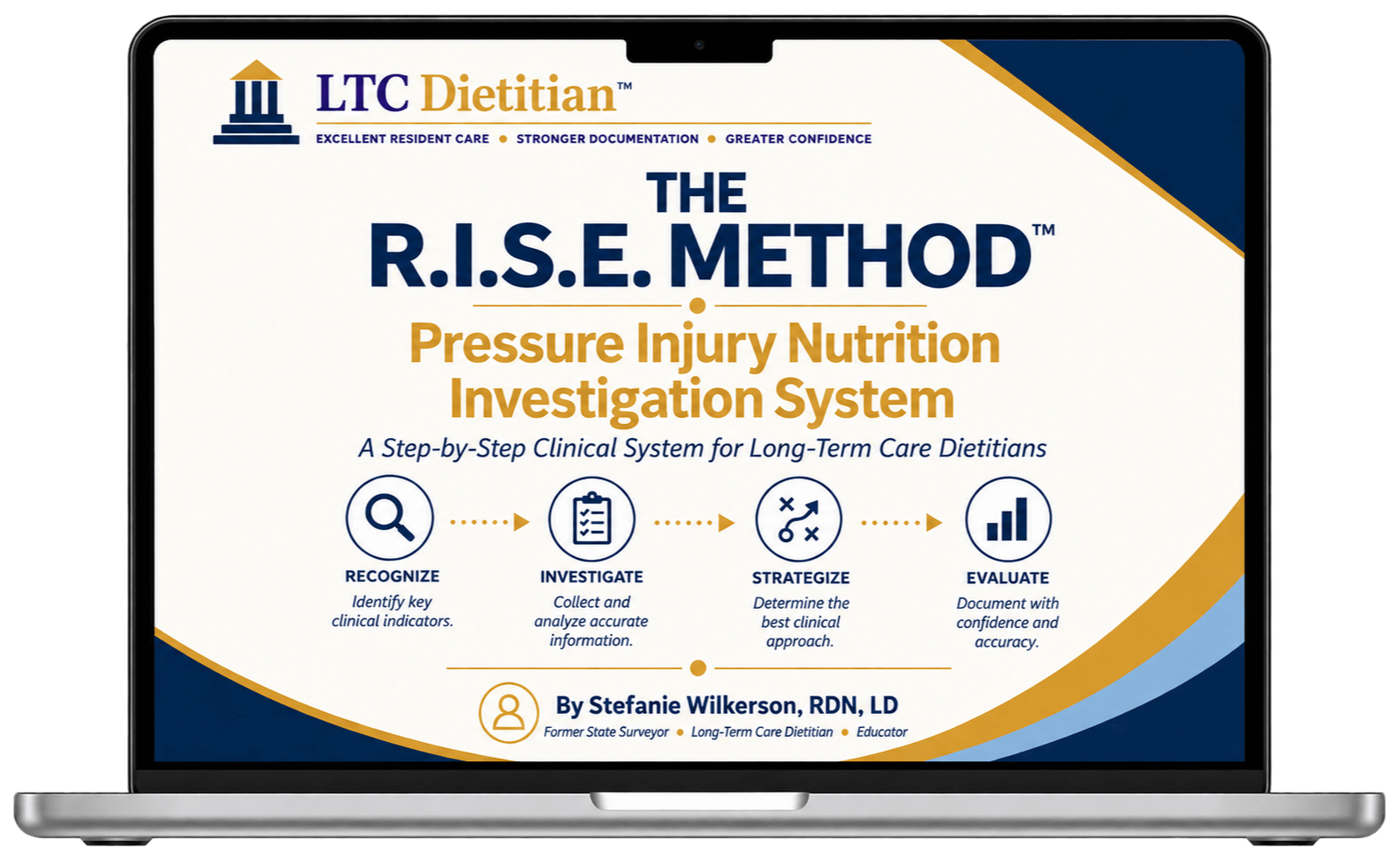
Table of contents
What's Included
The R.I.S.E. Philosophy™
Welcome
Quick Start: Pressure Injury Nutrition Response Workflow
Overview: The R.I.S.E. Method™
Overview: The Full R.I.S.E. Cycle
Recognize — Recognize Nutrition Risk & the Wound Trigger
Investigate — Comprehensive Nutrition & Wound Risk Review (Core / Explore)
Investigate — Laboratory & Evidence-Based Nutrition Targets
Investigate — A Note on Arginine, Glutamine, HMB & Combination Supplements (e.g., Juven®)
Investigate — Nursing Staff Interview
Investigate — Resident / Representative Interview Guide
Investigate — State the Working Nutrition Problem
Strategize — Cause-to-Intervention Planning Matrix
Strategize — Individualized Nutrition Care Plan
Strategize — Interdisciplinary Communication
Strategize — Provider SBAR Template
Strategize — Your Role in the Interdisciplinary Wound Review
Strategize — Informed Choice, Refusal & Risk Documentation
Evaluate — Nutrition Monitoring Dashboard
Evaluate — Your Contribution to the Avoidable/Unavoidable Determination
Evaluate — Documentation That Holds Up
Evaluate — Survey-Readiness Chart Audit
Facility Nutrition-Related Pressure Injury Trend Log
Completed Case Study: Mr. T
Completed Case Study: Mrs. K — When Nutrition Is Not the Limiter
30-Day Implementation Plan
Professional Use & References
Table of contents
What's Included
The R.I.S.E. Philosophy™
Welcome
Quick Start: Pressure Injury Nutrition Response Workflow
Overview: The R.I.S.E. Method™
Overview: The Full R.I.S.E. Cycle
Recognize — Recognize Nutrition Risk & the Wound Trigger
Investigate — Comprehensive Nutrition & Wound Risk Review (Core / Explore)
Investigate — Laboratory & Evidence-Based Nutrition Targets
Investigate — A Note on Arginine, Glutamine, HMB & Combination Supplements (e.g., Juven®)
Investigate — Nursing Staff Interview
Investigate — Resident / Representative Interview Guide
Investigate — State the Working Nutrition Problem
Strategize — Cause-to-Intervention Planning Matrix
Strategize — Individualized Nutrition Care Plan
Strategize — Interdisciplinary Communication
Strategize — Provider SBAR Template
Strategize — Your Role in the Interdisciplinary Wound Review
Strategize — Informed Choice, Refusal & Risk Documentation
Evaluate — Nutrition Monitoring Dashboard
Evaluate — Your Contribution to the Avoidable/Unavoidable Determination
Evaluate — Documentation That Holds Up
Evaluate — Survey-Readiness Chart Audit
Facility Nutrition-Related Pressure Injury Trend Log
Completed Case Study: Mr. T
Completed Case Study: Mrs. K — When Nutrition Is Not the Limiter
30-Day Implementation Plan
Professional Use & References
Get Immediate Access
Bring the R.I.S.E. Method™ Into Your LTC Practice
Stop rebuilding your pressure injury nutrition investigation process for every resident.
Download the complete system and begin using a clear framework to assess nutrition-related concerns, individualize interventions, strengthen documentation, improve interdisciplinary communication, and evaluate whether the nutrition plan is being implemented and is supporting the resident’s needs.
Get Immediate Access
Bring the R.I.S.E. Method™ Into Your LTC Practice
Stop rebuilding your pressure injury nutrition investigation process for every resident.
Download the complete system and begin using a clear framework to assess nutrition-related concerns, individualize interventions, strengthen documentation, improve interdisciplinary communication, and evaluate whether the nutrition plan is being implemented and is supporting the resident’s needs.
Created by Stefanie Wilkerson, RDN, LD
Stefanie Wilkerson is a Registered and Licensed dietitian with more than 25 years of long-term care experience, including experience as a State surveyor, LTC consultant, and educator. She created the R.I.S.E. Method™ to give long-term care dietitians a practical, repeatable way to investigate significant weight loss, strengthen documentation, and approach survey-sensitive concerns with greater clarity and confidence.

Created by Stefanie Wilkerson, RDN, LD
Stefanie Wilkerson is a Registered and Licensed dietitian with more than 25 years of long-term care experience, including experience as a State surveyor, LTC consultant, and educator. She created the R.I.S.E. Method™ to give long-term care dietitians a practical, repeatable way to investigate significant weight loss, strengthen documentation, and approach survey-sensitive concerns with greater clarity and confidence.








.......
Created Specifically for Long-Term Care Dietitians
The R.I.S.E. Method™ is designed for:
Consultant and facility-based long-term care dietitians.
Dietitians who want a more consistent pressure injury nutrition investigation process.
Dietitians strengthening documentation and survey readiness.
Dietitians training new team members or standardizing practices across multiple facilities.
Dietitians who want practical tools that remain focused on the dietitian’s responsibilities within interdisciplinary pressure injury care.
.......
Created Specifically for Long-Term Care Dietitians
The R.I.S.E. Method™ is designed for:
Consultant and facility-based long-term care dietitians.
Dietitians who want a more consistent pressure injury nutrition investigation process.
Dietitians strengthening documentation and survey readiness.
Dietitians training new team members or standardizing practices across multiple facilities.
Dietitians who want practical tools that remain focused on the dietitian’s responsibilities within interdisciplinary pressure injury care.
More Than a Generic Pressure Injury Checklist
The R.I.S.E. Method™ was developed from the perspective of both a long-term care dietitian and former state surveyor. It is designed to help you connect the entire clinical story:
What nutrition concerns are present → what may be contributing to them → what interventions were selected → whether the plan was implemented → how the resident responded
Instead of handing you a few blank forms or a list of standard nutrition recommendations, the system walks you through the clinical reasoning, documentation, communication, and follow-up needed to support individualized resident care to support wound healing.
GET IMMEDIATE ACCESSMore Than a Generic Pressure Injury Checklist
The R.I.S.E. Method™ was developed from the perspective of both a long-term care dietitian and former state surveyor. It is designed to help you connect the entire clinical story:
What nutrition concerns are present → what may be contributing to them → what interventions were selected → whether the plan was implemented → how the resident responded
Instead of handing you a few blank forms or a list of standard nutrition recommendations, the system walks you through the clinical reasoning, documentation, communication, and follow-up needed to support individualized resident care to support wound healing.
GET IMMEDIATE ACCESS
A Case Study Built for the Hard Question
Sometimes a wound isn't improving even though the resident's nutrition needs are already being met. Recognizing that, and documenting it clearly, is one of the most valuable things you bring to the table.
The R.I.S.E. Method™ includes a completed case study on identifying when nutrition is not the limiting factor in wound healing — and how to document that finding clearly.
A Case Study Built for the Hard Question
Sometimes a wound isn't improving even though the resident's nutrition needs are already being met. Recognizing that, and documenting it clearly, is one of the most valuable things you bring to the table.
The R.I.S.E. Method™ includes a completed case study on identifying when nutrition is not the limiting factor in wound healing — and how to document that finding clearly.
FAQs
FAQs
Is this a course?
No. The R.I.S.E. Method™ is a downloadable pressure injury nutrition investigation system and professional workbook delivered through the LTC Dietitian learning portal. Rather than video-based instruction, you will receive a structured, step-by-step process with worksheets, investigation tools, documentation guidance, chart-review resources, and practical forms you can download, use in practice, and return to whenever needed.
Can an entire facility use one purchase?
A single purchase is licensed to the individual buyer for use in their own professional practice, including the facilities they personally serve. The materials may not be copied, distributed, uploaded to a shared facility system, or provided to other dietitians, facilities, or users without a separate licensing agreement.
Does this replace clinical judgement or facility policy?
No. The system supports the dietitian’s assessment, documentation, care planning, communication, and follow-up process. It does not replace professional judgment, individualized assessment, current evidence-based guidance, medical direction, applicable regulations, wound care protocols, or facility policies and procedures.
Is this intended to replace the wound's care assessment?
No. This system is specifically focused on the long-term care dietitian’s role in pressure injury care. It supports the dietitian’s nutrition assessment, intervention planning, documentation, interdisciplinary communication, and follow-up. It does not replace wound assessment, staging, medical treatment, nursing care, practitioner direction, or the responsibilities of other members of the interdisciplinary team.
Get Immediate Access
Bring the R.I.S.E. Method™ Into Your LTC Practice
Stop rebuilding your pressure injury nutrition investigation process for every resident.
Download the complete system and begin using a clear framework to assess nutrition-related concerns, individualize interventions, strengthen documentation, improve interdisciplinary communication, and evaluate whether the nutrition plan is being implemented and is supporting the resident’s needs.
Get Immediate Access
Bring the R.I.S.E. Method™ Into Your LTC Practice
Stop rebuilding your pressure injury nutrition investigation process for every resident.
Download the complete system and begin using a clear framework to assess nutrition-related concerns, individualize interventions, strengthen documentation, improve interdisciplinary communication, and evaluate whether the nutrition plan is being implemented and is supporting the resident’s needs.