
Get Immediate Access for $67
MDS Section K Made Practical
A practical guide to help long-term care dietitians connect clinical assessment, supporting documentation, interdisciplinary communication, accurate coding, and regulatory expectations.
GET THE GUIDE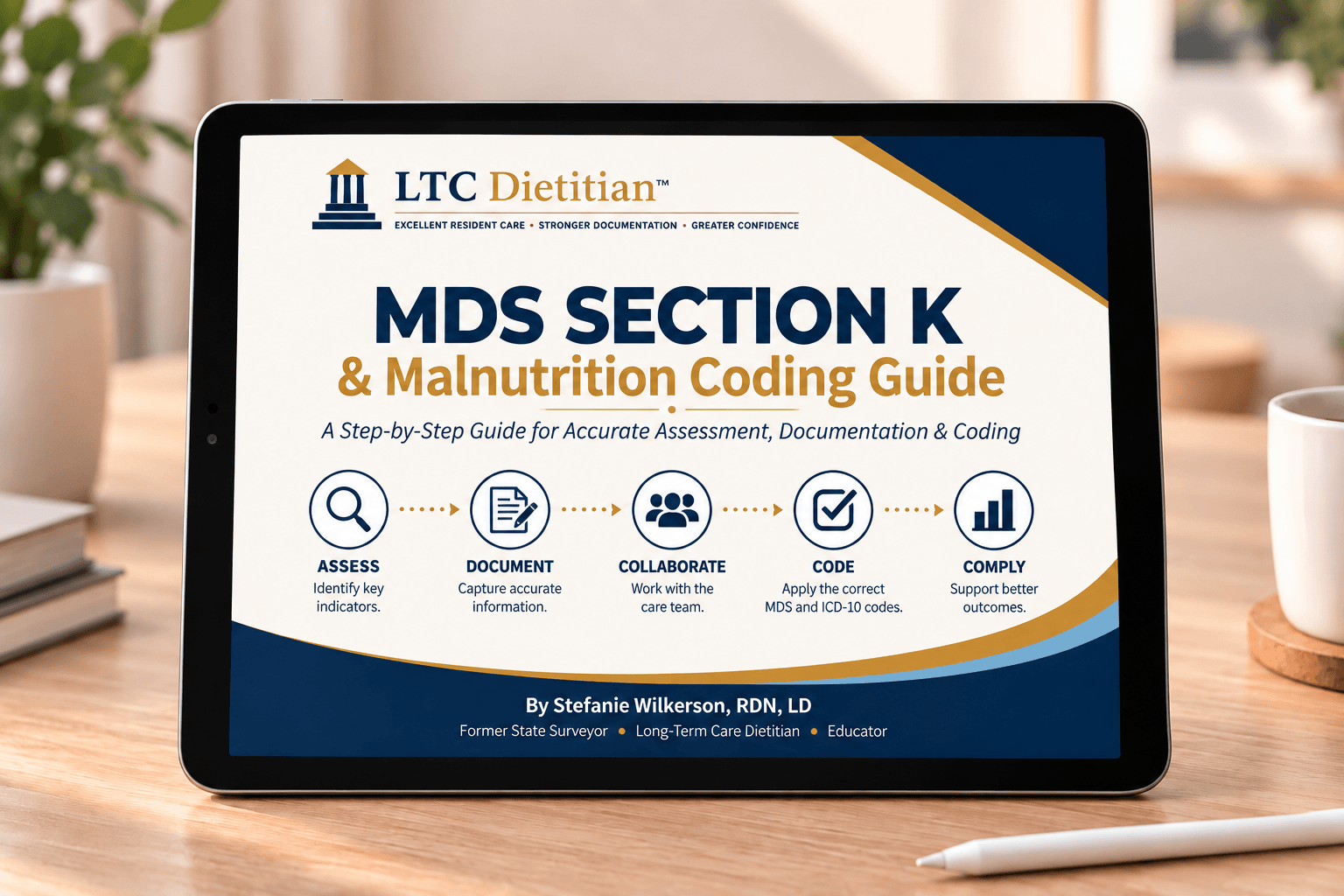
Get Immediate Access for $67
MDS Section K Made Practical
A practical guide to help long-term care dietitians connect clinical assessment, supporting documentation, interdisciplinary communication, accurate coding, and regulatory expectations.
GET THE GUIDE.......
Malnutrition coding is rarely as simple as checking a box
MDS Section K coding requires more than recognizing that a resident may be malnourished.
The dietitian must understand the coding criteria, complete a thorough clinical assessment, communicate findings to the appropriate members of the interdisciplinary team, and ensure the medical record contains documentation that supports the resident’s condition.
When those pieces do not align, even appropriate clinical care may not be accurately reflected on the MDS. This guide was created to help you bring the entire process together with greater clarity and confidence.
.......
Malnutrition coding is rarely as simple as checking a box
MDS Section K coding requires more than recognizing that a resident may be malnourished.
The dietitian must understand the coding criteria, complete a thorough clinical assessment, communicate findings to the appropriate members of the interdisciplinary team, and ensure the medical record contains documentation that supports the resident’s condition.
When those pieces do not align, even appropriate clinical care may not be accurately reflected on the MDS. This guide was created to help you bring the entire process together with greater clarity and confidence.
Clinical Care + Documentation + Regulatory Accuracy
The guide connects the clinical and regulatory responsibilities involved in MDS Section K and malnutrition coding:
Clinical Assessment - Supporting Documentation - Interdisciplinary Communication - Accurate Coding - Regulatory Compliance - Survey Readiness
The goal is not simply to complete an MDS item correctly. It is to ensure the coding accurately reflects the resident’s condition, the assessment performed, the care provided, and the supporting documentation in the medical record..
Clinical Care + Documentation + Regulatory Accuracy
The guide connects the clinical and regulatory responsibilities involved in MDS Section K and malnutrition coding:
Clinical Assessment
Supporting Documentation
Interdisciplinary Communication
Accurate Coding
Regulatory Compliance
Survey Readiness
The goal is not simply to complete an MDS item correctly. It is to ensure the coding accurately reflects the resident’s condition, the assessment performed, the care provided, and the supporting documentation in the medical record.

Use the guide to strengthen your approach to:

Reviewing nutrition-related items within MDS Section K
Understanding the connection between clinical findings and coding requirements
Identifying documentation needed to support malnutrition coding
Distinguishing nutrition assessment from diagnosis and MDS coding
Communicating findings with nursing, providers, and the MDS team
Recognizing common documentation and coding gaps
Connecting individualized resident care with regulatory compliance
Preparing documentation that more clearly supports survey review

Use the guide to strengthen your approach to:
Reviewing nutrition-related items within MDS Section K
Understanding the connection between clinical findings and coding requirements
Identifying documentation needed to support malnutrition coding
Distinguishing nutrition assessment from diagnosis and MDS coding
Communicating findings with nursing, providers, and the MDS team
Recognizing common documentation and coding gaps
Connecting individualized resident care with regulatory compliance
Preparing documentation that more clearly supports survey review
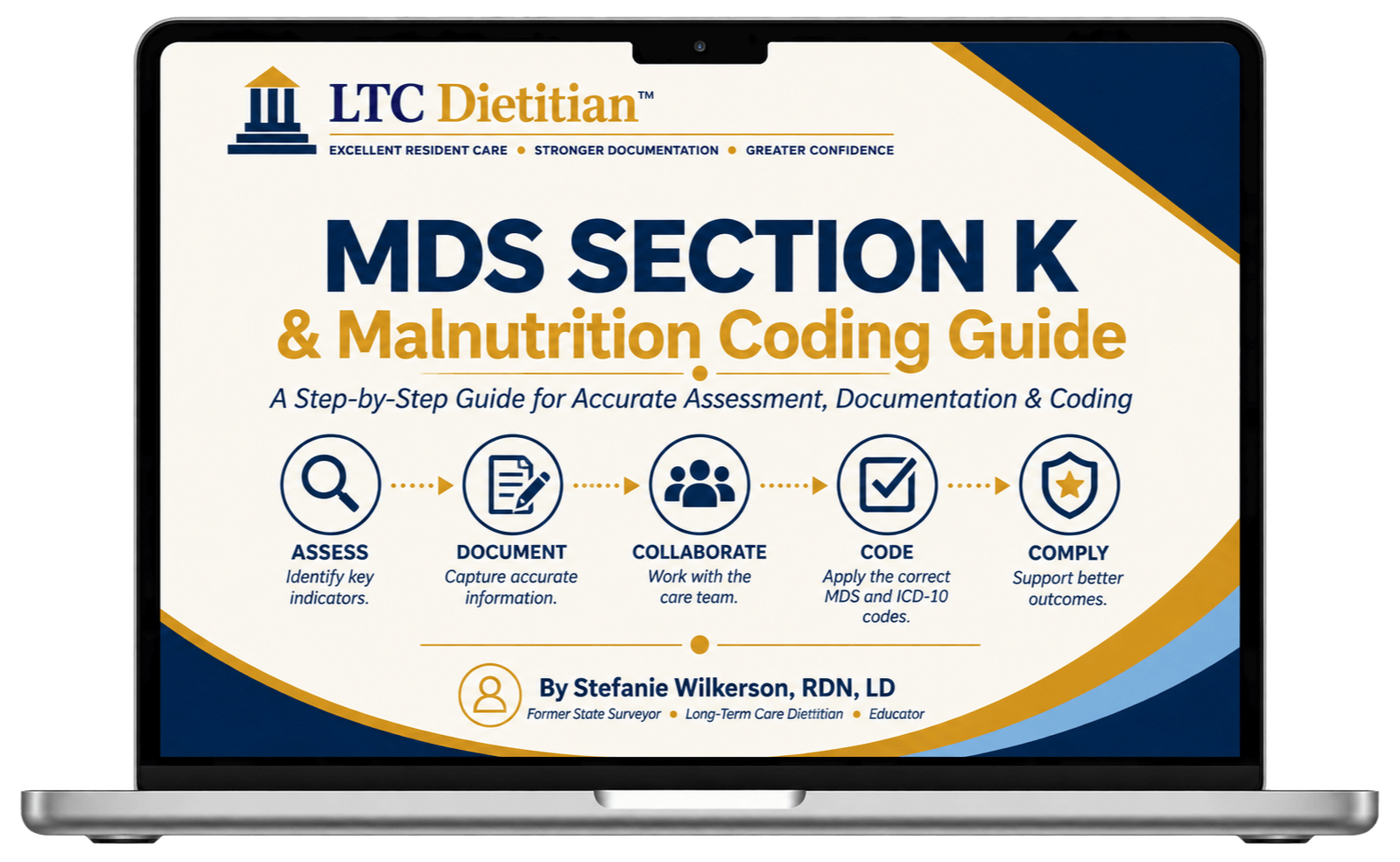
Table of contents
What's Included
The R.I.S.E. Philosophy™
Welcome
Section K at a Glance
Quick Start: Coding Decision Workflow
Overview: The R.I.S.E. Method™
Recognize — Identify the Coding Decision You're Facing
Investigate — Weight Coding Decision Guide (K0300/K0310)
Investigate — Nutritional Approaches Decision Guide (K0520) 1
Investigate — Therapeutic Diet Decision Guide 1
Investigate — Malnutrition Diagnosis Criteria (Section I)
Investigate — Practice Scenarios: How Should This Be Coded?
Strategize — Applying & Explaining Your Coding Decision
Evaluate — Confidence Self-Check
Evaluate — Quick-Reference Decision Summary
Facility Coding Question Log
Completed Case Study
30-Day Coding Confidence Plan
Professional Use & References
Table of contents
What's Included
The R.I.S.E. Philosophy™
Welcome
Section K at a Glance
Quick Start: Coding Decision Workflow
Overview: The R.I.S.E. Method™
Recognize — Identify the Coding Decision You're Facing
Investigate — Weight Coding Decision Guide (K0300/K0310)
Investigate — Nutritional Approaches Decision Guide (K0520) 1
Investigate — Therapeutic Diet Decision Guide 1
Investigate — Malnutrition Diagnosis Criteria (Section I)
Investigate — Practice Scenarios: How Should This Be Coded?
Strategize — Applying & Explaining Your Coding Decision
Evaluate — Confidence Self-Check
Evaluate — Quick-Reference Decision Summary
Facility Coding Question Log
Completed Case Study
30-Day Coding Confidence Plan
Professional Use & References
Get Immediate Access
Bring greater clarity to MDS Section K and malnutrition coding.
Strengthen the connection between your clinical assessment, documentation, interdisciplinary communication, coding decisions, and regulatory responsibilities.
Get Immediate Access
Bring greater clarity to MDS Section K and malnutrition coding.
Strengthen the connection between your clinical assessment, documentation, interdisciplinary communication, coding decisions, and regulatory responsibilities.
Created by Stefanie Wilkerson, RDN, LD
I’m Stefanie Wilkerson, RDN, LD, former State surveyor, long-term care dietitian, educator, consultant, and founder of LTC Dietitian™.
Throughout my career, I've had the opportunity to view long-term care from both the clinical and regulatory perspectives. I created this guide to help dietitians better understand the connection between nutrition assessment, supporting documentation, MDS Section K coding, and regulatory expectations—so they can approach the process with greater clarity and confidence.

Created by Stefanie Wilkerson, RDN, LD
I’m Stefanie Wilkerson, RDN, LD, former State surveyor, long-term care dietitian, educator, consultant, and founder of LTC Dietitian™.
Throughout my career, I've had the opportunity to view long-term care from both the clinical and regulatory perspectives. I created this guide to help dietitians better understand the connection between nutrition assessment, supporting documentation, MDS Section K coding, and regulatory expectations—so they can approach the process with greater clarity and confidence.








.......
Who is this guide for?
This guide was created for long-term care dietitians who want greater confidence in the relationship between nutrition assessment, malnutrition documentation, MDS Section K coding, and regulatory expectations.
Whether you're new to long-term care or have years of experience, this guide provides a practical reference to help you better understand how these pieces fit together in everyday practice.
.......
Who is this guide for?
This guide was created for long-term care dietitians who want greater confidence in the relationship between nutrition assessment, malnutrition documentation, MDS Section K coding, and regulatory expectations.
Whether you're new to long-term care or have years of experience, this guide provides a practical reference to help you better understand how these pieces fit together in everyday practice.
FAQs
FAQs
Is this a course?
No. Think of it as a professional reference guide rather than a course. It provides practical guidance on MDS Section K, malnutrition coding, documentation, and regulatory considerations in a format you can review at your own pace and revisit whenever needed.
Is this only for MDS coordinators?
No. It was created primarily for long-term care dietitians, but it also supports clearer interdisciplinary communication with MDS coordinators, nursing, providers, and other members of the care team.
Is this guide right for me?
If you're a long-term care dietitian who wants a better understanding of MDS Section K, malnutrition coding, supporting documentation, and the related regulatory expectations, this guide was created for you. Whether you're new to long-term care or simply want greater confidence in this area, you'll find practical guidance you can immediately apply.
Does this replace RAI User's Manual or current CMS guidance?
No. The guide is designed to support professional understanding and judgment. Current CMS guidance, the RAI User’s Manual, facility policies, state requirements, and applicable professional standards should always be followed.
Is this only for significant weight loss?
No. While the R.I.S.E. Method™ is designed to help investigate clinically significant weight loss, it is equally valuable for evaluating concerning weight trends before they become significant. The same structured process helps you verify the concern, identify contributing factors, develop individualized interventions, and document your clinical reasoning—whether you're responding to a significant weight loss or proactively addressing a developing trend.
Can I download the guide?
Yes. The guide is a downloadable PDF, making it easy to save for future reference and use in your day-to-day practice.
Get Immediate Access
Bring greater clarity to MDS Section K and malnutrition coding.
Strengthen the connection between your clinical assessment, documentation, interdisciplinary communication, coding decisions, and regulatory responsibilities.
Get Immediate Access
Bring greater clarity to MDS Section K and malnutrition coding.
Strengthen the connection between your clinical assessment, documentation, interdisciplinary communication, coding decisions, and regulatory responsibilities.