
Behind the Deficiency: “The Food Is Terrible.” Are We Treating That as Clinical Information?
Nov 03, 2026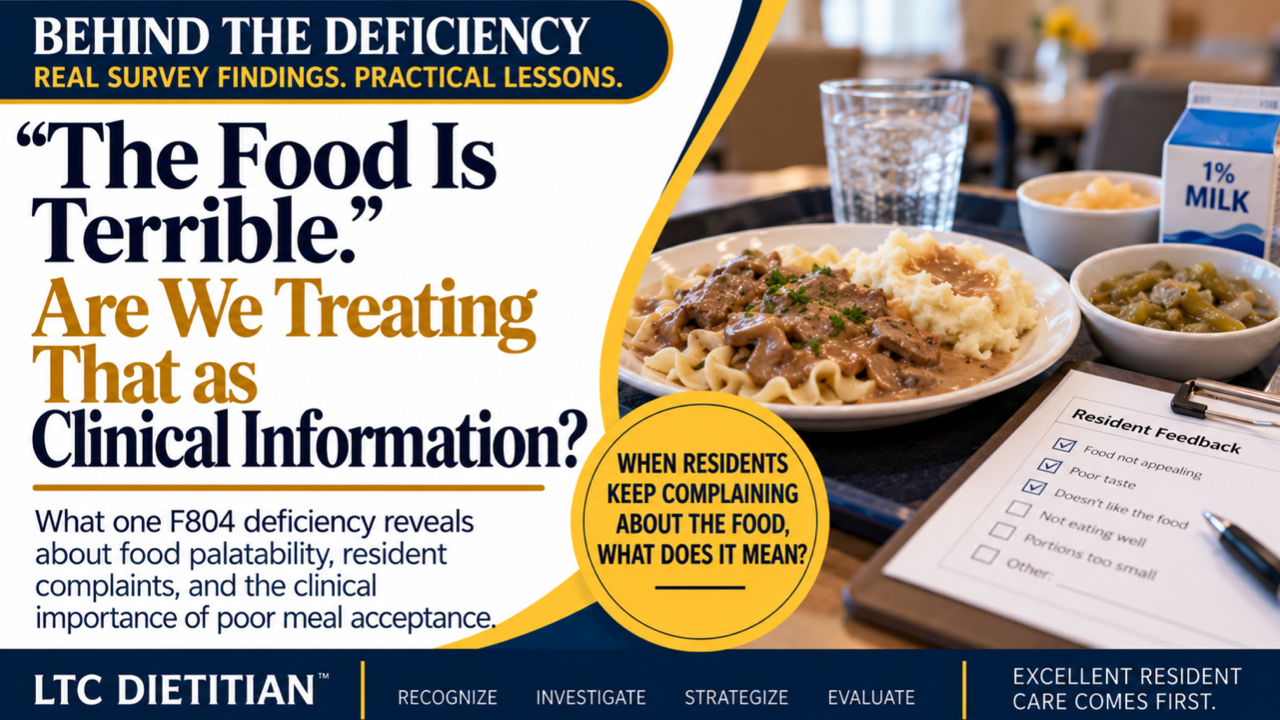
By Stefanie Wilkerson, RDN, LD
Former State Surveyor | Over 25 Years as a Registered Dietitian | Long-Term Care Educator
“The resident doesn't like the food.”
It can be easy to hear that statement and categorize it as a food-service complaint.
But what happens when the complaint keeps occurring?
And what happens when the resident also has poor intake?
The Actual Deficiency
Facility: Arcadia Care Morton
Location: Morton, Illinois
Survey completed: February 20, 2025
F-Tag: F804 — Nutritive Value/Appear, Palatable/Prefer Temp
Scope/Severity: F — Potential for more than minimal harm; widespread
Surveyors found that the facility failed to serve food that was visually appealing and palatable.
The finding had the potential to affect 78 residents prescribed oral intake.
During observation of a lunch meal containing beef stroganoff, steamed zucchini, and chilled pears, surveyors observed zucchini being plated without being adequately drained. Liquid from the zucchini mixed with the stroganoff and caused the meal to appear watery and unappetizing.
Several residents did not eat the meal and requested an alternative.
Resident interviews identified concerns about food temperature, taste, and excessive saltiness.
The Ombudsman told surveyors that food palatability was a recurring issue raised monthly at resident council meetings and was often not addressed by staff.
This was not simply one resident disliking one lunch.
There was a pattern.
Original CMS-2567:
https://marsproject.blob.core.windows.net/cms-data/145248-healthstandard-2025-02-20.pdf
Palatability Is Part of Nutrition Care
A menu can meet calculated calorie and protein requirements on paper and still fail the resident.
Why?
Because residents have to eat it.
We routinely investigate medications, diagnoses, swallowing problems, GI symptoms, depression, functional decline, and feeding assistance when intake decreases.
We should.
But food acceptance belongs in that investigation too.
If someone routinely eats 25% of meals, the first question should not automatically be:
What supplement should we add?
Another important question is:
Why isn't the resident eating the meal?
Listen for Patterns
One complaint may be one complaint.
Repeated comments deserve a closer look.
Listen for statements such as:
-
“The food is always cold.”
-
“The meat is too tough.”
-
“I can't chew it.”
-
“They never send anything I like.”
-
“The vegetables are mushy.”
-
“Everything tastes too salty.”
-
“I've told them I don't eat that.”
Those comments provide information.
Resident council minutes provide information.
Dining observations provide information.
Plate waste provides information.
And CNAs assisting residents at meals may know things that never appear in the nutrition note.
What Is the RD's Role?
The Registered Dietitian does not have to personally resolve every kitchen complaint.
But we do need to recognize when food quality or acceptance may contribute to nutritional risk.
That may mean:
-
talking directly with the resident;
-
observing meals;
-
reviewing recurring resident concerns;
-
discussing patterns with the Dietary Manager;
-
determining whether acceptable alternatives are available;
-
checking whether individual food preferences are being incorporated;
-
and considering palatability when investigating poor intake or weight change.
Before You Add Another Intervention
If a resident eats 25% of most meals, a supplement may absolutely be appropriate.
But first ask:
Do we know why the resident is eating 25%?
Because sometimes poor intake is not primarily a medical problem.
Sometimes the resident simply does not want to eat what is put in front of them.
And that is clinical information too.
Frequently Asked Questions
Does One Resident Complaint Mean the Facility Is Out of Compliance?
Not necessarily. Survey findings are based on the totality of evidence. A recurring pattern of complaints, observations, interviews, and failure to address identified concerns is different from one isolated preference complaint.
Why Should an RD Review Resident Council Concerns?
Recurring food and dining concerns may reveal system problems that affect intake, satisfaction, preferences, and ultimately nutritional status.
Should Poor Food Acceptance Be Investigated Before Starting a Supplement?
It should be considered as part of the investigation. A supplement may still be appropriate, but it should not automatically replace identifying why the resident is not eating meals.
Is Palatability Really a Regulatory Issue?
Yes. F804 addresses food and drink being palatable, attractive, and served at safe and appetizing temperatures.
Take the Next Step
Use the free LTC Survey Readiness Toolkit to strengthen your review of dining practices, high-risk residents, documentation, and nutrition-related survey concerns.
Get the free LTC Survey Readiness Toolkit:
https://www.ltcdietitian.com/
For deeper regulatory education designed specifically for Registered Dietitians working in long-term care:
Explore the Advanced Certificate in Long-Term Care Survey & Regulatory Compliance:
https://www.ltcdietitian.com/courses/beasurveyreadyrdn
References
-
Centers for Medicare & Medicaid Services. Arcadia Care Morton. CMS-2567 Statement of Deficiencies. Survey completed February 20, 2025.
https://marsproject.blob.core.windows.net/cms-data/145248-healthstandard-2025-02-20.pdf -
Centers for Medicare & Medicaid Services. State Operations Manual, Appendix PP — Guidance to Surveyors for Long Term Care Facilities.
https://www.cms.gov/medicare/provider-enrollment-and-certification/guidanceforlawsandregulations/downloads/appendix-pp-state-operations-manual.pdf
Facility Disclaimer
Facility names and survey findings are included for educational purposes based on publicly available CMS survey records from the dates identified above. Discussion of a historical deficiency does not imply that the cited practice continued after the survey or reflect the facility's current compliance status, quality of care, ownership, staffing, or operations. LTC Dietitian™ is not affiliated with the facility or CMS.