
The Chart Says 75% Intake. But 75% of What?
Oct 12, 2026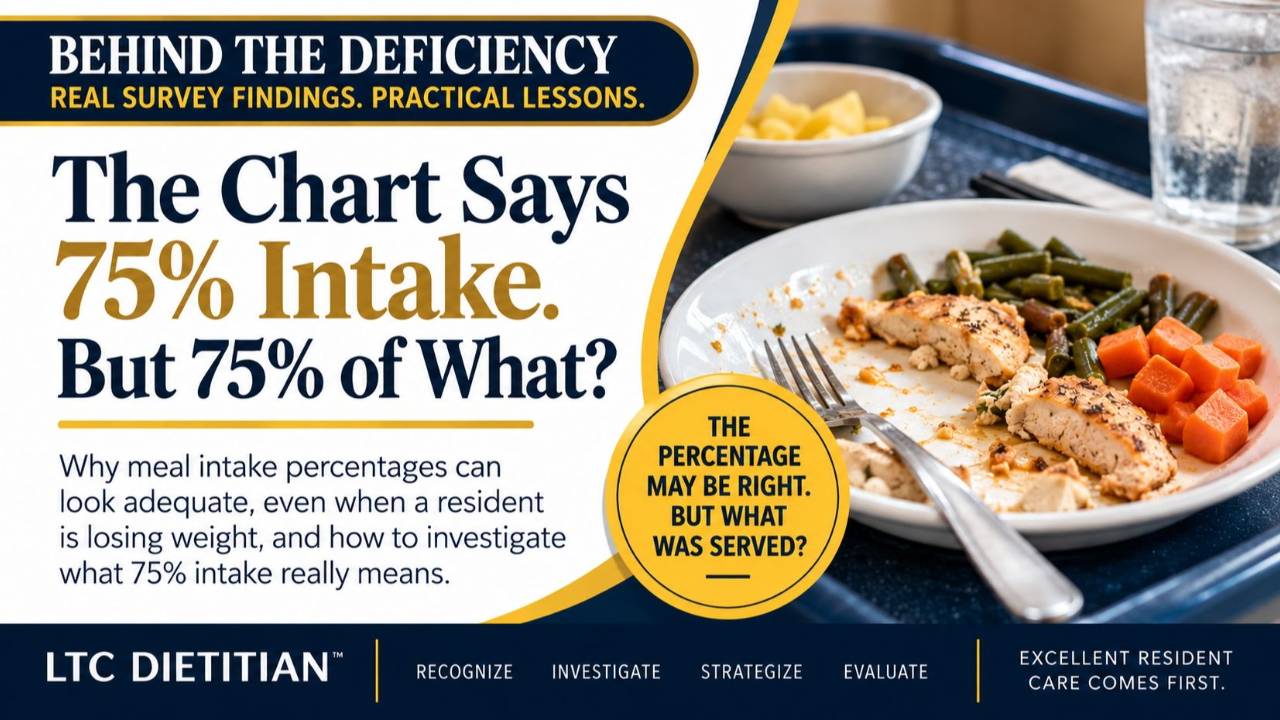
By Stefanie Wilkerson, RDN, LD
A resident is losing weight.
You pull up the meal intake records and see:
75%. 50–75%. 75–100%.
At first glance, intake doesn’t look terrible.
But before deciding the resident is eating adequately, there’s another question worth asking:
75% of what?
-
Was it 75% of the standard meal on the menu?
-
Was it 75% of what the resident selected?
-
Was the planned entrée refused and a substitution provided?
-
Was it 75% of a smaller portion?
And, perhaps most importantly, was 75% actually consumed at all?
Meal intake percentages are a routine part of nutrition monitoring in long-term care. Dietitians use them when assessing weight loss, evaluating interventions, monitoring residents at nutrition risk, and determining whether a resident’s intake appears adequate.
But the percentage alone doesn’t always tell us what the resident is actually eating.
When Meal Intake Documentation Doesn’t Match What Happened
This isn’t only a hypothetical concern.
In a 2025 long-term care survey, a resident experienced a 6.3% unplanned weight loss in one month. The facility was cited under F692 – Nutrition/Hydration Status Maintenance after surveyors identified concerns related to the resident’s nutritional care, including inconsistent meal intake monitoring and inaccurate intake documentation.
In one instance, 100% intake was documented for both breakfast and lunch. During an interview, the CNA stated the resident had not eaten breakfast and had eaten less than 50% of lunch. The CNA could not explain why 100% had been documented.
The facility also had a process requiring staff to report intake below 75% over a specified period. That made accurate intake documentation important not only for the medical record, but also for triggering follow-up. Timely communication when a significant weight change is identified is another critical part of the process, as discussed in How a Weight Loss Notification Gap Creates Risk Under More Than One Tag.
When the intake record is inaccurate, the problem is fairly easy to recognize: the number itself is wrong.
But there is another problem that can be much harder to see. Sometimes the percentage is completely accurate. The resident really did eat 75%.
The question is still: 75% of what?
What Research Shows About Meal Intake Percentages
Research has also demonstrated the limitations of relying on routinely documented meal intake percentages in nursing homes.
In a nursing home validation study (Simmons & Reuben, 2000), researchers compared staff documentation of residents’ food and fluid intake with direct observation and pre- and post-meal photography.
Staff documentation overestimated total intake by approximately 22%.
Even more concerning, the documentation failed to identify 53% of residents who consumed 75% or less of their meals most of the time.
For the dietitian, that matters. Meal intake percentages are valuable information, but they are still estimates. When a resident is losing weight despite documentation that appears to show adequate intake, the numbers should be one part of the investigation, not the end of it.
Sometimes 75% Really Is 75%
Now consider a different situation. A staff member accurately documents that a resident consumed 75% of lunch.
But if that lunch was a substitution, a smaller portion, or a meal the resident selected in place of the planned entrée, the 75% may be completely accurate and still not provide the same calories, protein, or overall nutritional value as the planned meal.
That distinction becomes especially important when the same pattern occurs repeatedly. A resident who routinely eats 75% of the planned meal may have a very different intake from a resident who routinely eats 75% of a smaller meal or a lower-calorie substitution.
The documentation isn’t necessarily wrong. It just may not tell us enough.
Investigating Meal Intake and Weight Loss in Long-Term Care
When the documented intake doesn’t match the resident’s weight trend or overall clinical picture, don’t stop with the percentages. Use three tools together:
-
Review the record. Look beyond the percentages. Review the weight trend, meal selections when available, substitutions, supplements, nutrition interventions, and patterns in intake over time.
-
Observe the meal. Go to the dining room or the resident’s room during a meal. Was the planned meal served, or a substitution or smaller portion? Is the resident eating the entrée or mostly the sides and dessert? Is assistance being provided as care planned?
-
Interview the resident and staff. Talk with the resident and the staff who assist at meals. Does the resident frequently refuse the entrée or ask for substitutions? Eat better at certain meals? Consistently leave certain foods untouched?
This is also why tray line audits matter. If the portion sizes listed on the menu aren’t being served in the first place, even an accurately documented intake percentage may not reflect the amount of food you think the resident received.
Sometimes the information needed to understand a resident’s weight loss isn’t found on another screen in the EHR. You need to see what is actually happening at the meal. Direct observation lets you compare what is documented with what is actually served, what the resident actually eats, and what happens during the meal.
Once You Know What’s Happening, Strategize
The goal isn’t to create more documentation for the sake of documentation. It’s to make sure the information being collected is useful enough to guide the resident’s care.
-
If substitutions are common, determine whether they are meeting the resident’s nutritional needs.
-
If routine percentages aren’t giving you enough information during a weight loss investigation, consider obtaining more detailed intake information for a defined period.
-
If the resident consistently refuses certain foods, use what you learned through observation and interviews to develop interventions that better fit the resident’s preferences and usual eating patterns.
-
When a substitution, refusal, or other significant change makes the meal percentage difficult to interpret, work with the interdisciplinary team on a practical way to communicate that information.
Then evaluate. Did intake improve? Did the resident accept the new interventions? Did the weight stabilize?
If not, the investigation isn’t finished.
Before You Accept the Percentage
Meal intake percentages can be useful, but they should never replace clinical judgment. When the numbers don’t seem to match what is happening with the resident, look further.
Review the record. Observe the meal. Talk to the resident and the staff.
And before accepting “75% intake” as evidence that a resident is eating adequately, ask one more question:
75% of what?
If you’re looking for a structured way to work through weight loss investigations in long-term care, the R.I.S.E. Method™ Weight Loss Investigation System walks you through recognizing the concern, investigating potential causes, developing individualized strategies, and evaluating the resident’s response.
→ Learn more about the R.I.S.E. Method™ Weight Loss Investigation System
Frequently Asked Questions About Meal Intake Documentation in Long-Term Care
Is documenting a meal intake percentage enough to determine whether a resident is eating adequately?
Not necessarily. A percentage tells you how much of the food served was reportedly consumed, but it may not tell you what was served, whether the resident received a substitution or smaller portion, or whether the foods consumed provided adequate calories and protein. When intake percentages do not match the resident’s weight trend or clinical condition, further investigation is needed.
What should a dietitian review when a resident is losing weight despite apparently adequate meal intake?
Look beyond the documented percentages. Review the resident’s weight trend, meal selections, substitutions, supplements, nutrition interventions, and intake patterns. Directly observe meals and interview the resident and staff to determine what is actually being served and consumed.
Why are meal observations important during a weight loss investigation?
Meal observations allow the dietitian to compare the medical record with what is actually happening. Observation can identify issues such as incorrect portions, frequent substitutions, food refusals, inadequate assistance, or other factors that may not be apparent from the intake record alone.
Why are tray line audits important for nutrition monitoring in long-term care?
Tray line audits help verify that residents receive the foods and portion sizes specified by the menu and their individual diet orders. If the portion served is incorrect, even an accurately recorded meal intake percentage may give a misleading picture of the resident’s actual intake.
How accurate is staff-documented meal intake in nursing homes?
Staff-documented intake may overestimate what a resident actually consumes. One nursing home validation study found that staff documentation overestimated total intake by about 22% and failed to identify 53% of residents who consumed 75% or less of their meals most of the time.
References
Centers for Medicare & Medicaid Services. Statement of Deficiencies and Plan of Correction, Bethel Nursing Home Company Inc., survey completed March 21, 2025. F692 – Nutrition/Hydration Status Maintenance. CMS-2567
Simmons SF, Reuben D. Nutritional Intake Monitoring for Nursing Home Residents: A Comparison of Staff Documentation, Direct Observation, and Photography Methods. Journal of the American Geriatrics Society. 2000;48(2):209–213. PubMed