
Behind the Deficiency: The Calorie Count Confirmed Inadequate Intake. Then What?
Oct 19, 2026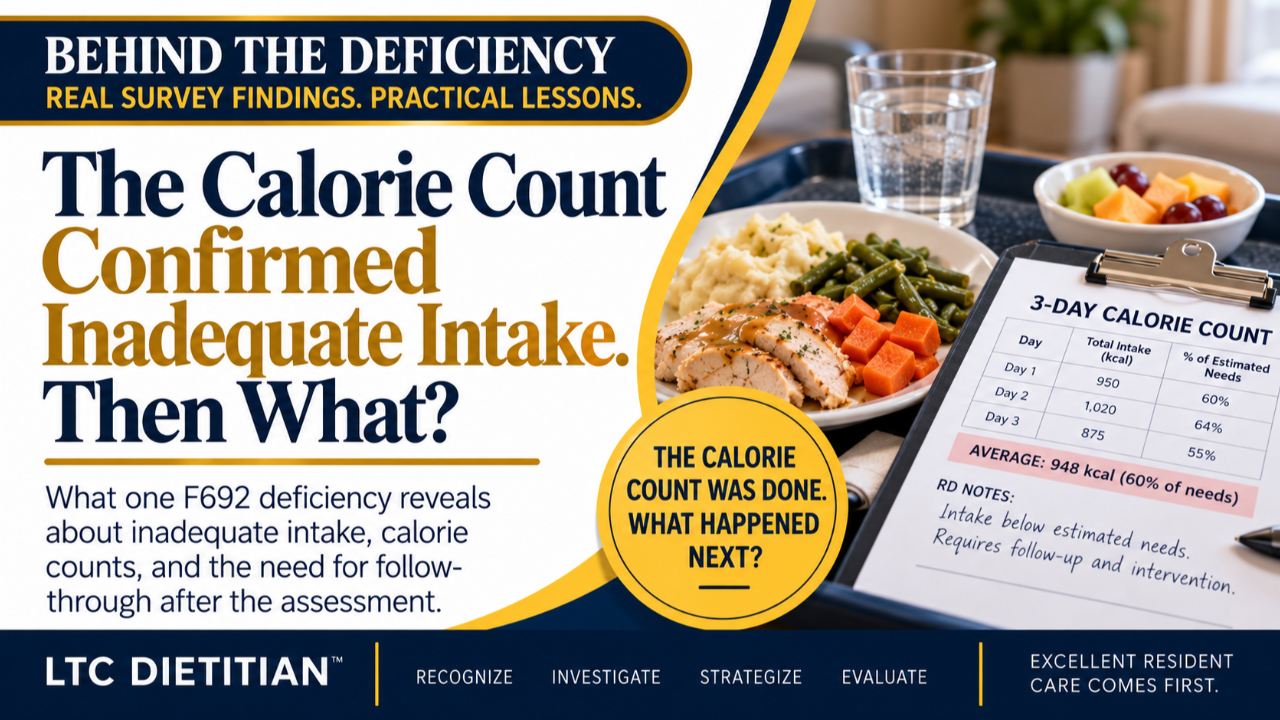
By Stefanie Wilkerson, RDN, LD
The Registered Dietitian recognized the significant weight loss.
A reweigh was obtained.
A three-day calorie count was completed.
The results confirmed the resident was not meeting estimated calorie or protein needs.
And then?
The facility was cited under F692. According to the survey findings, there was no documented evidence that the RD recommended or implemented an additional nutrition intervention after the calorie-count results.
That is where this deficiency becomes especially important for long-term care dietitians.
Because the problem wasn't that the weight loss went unnoticed.
The problem was what happened after the investigation confirmed there was a problem.
What Happened
During a recertification survey completed in July 2025, surveyors reviewed the nutrition care of a resident who had experienced significant weight loss.
The resident weighed 211.9 pounds on January 7.
By February 4, the resident weighed 200.6 pounds, a loss of 11.3 pounds, or 5.3%, in approximately one month.
The Registered Dietitian identified the loss as significant and requested a reweigh. The reweigh confirmed continued loss at 199 pounds.
The RD then recommended a three-day calorie count.
So far, there was a logical progression:
Weight loss identified → weight verified → intake investigated.
The calorie count was completed, and the RD documented that the resident was not meeting estimated calorie and protein needs.
But no additional nutrition intervention was documented after those results.
By March 4, the resident weighed 192.5 pounds, another 8.1-pound loss in approximately one month. That's a total loss of 19.4 pounds, about 9.2%, in roughly two months.
The RD Knew Why the Resident Was Losing Weight
During the survey interview, the Registered Dietitian explained that no nutritional changes had been made because the resident's weight loss was believed to be related to cognitive decline.
That piece is important.
Sometimes we identify what appears to be a reasonable explanation for weight loss:
- dementia or cognitive decline
- disease progression
- decreased appetite
- food refusal
- medication effects
- increased dependence with eating
- end-of-life changes
Identifying a likely cause is part of the investigation.
But identifying the cause does not necessarily mean the investigation, or our responsibility to respond, ends there.
CMS guidance for F692 directs surveyors to determine whether the facility identified residents at nutritional risk and identified, implemented, monitored, and modified interventions as appropriate based on the resident's assessed needs, choices, preferences, goals, and professional standards of practice (CMS State Operations Manual, Appendix PP).
That distinction matters.
"We know why the resident is losing weight" is not the same as "there is nothing more we can reasonably do."
The Calorie Count Answered the Question
Think about why we order a calorie count in the first place.
We are trying to answer a clinical question: is the resident consuming enough to meet estimated needs?
In this case, the answer was no.
Once the calorie count demonstrated inadequate calorie and protein intake, that information should have driven the next step in the clinical process.
The facility's own calorie-count policy stated that when results indicated a need for further assessment or intervention, the dietitian would make recommendations in the medical record and communicate them to the medical practitioner and nursing staff.
That is an important lesson for Registered Dietitians:
Don't perform an investigation without deciding what you are going to do with the results.
A calorie count is not the intervention. It is an assessment tool.
A reweigh is not the intervention. It verifies the problem.
A nutrition note documenting the loss is not the intervention either.
Each of those steps provides information that should help determine what happens next. And the information itself needs to be accurate. Routine intake percentages can look adequate even when a resident is losing weight, as discussed in The Chart Says 75% Intake. But 75% of What?
"But the Resident Was Already Receiving Ensure"
The resident already had an order for Ensure Plus four ounces four times daily.
During the survey interview, however, the RD acknowledged that the resident did not always accept the Ensure Plus.
The RD also stated that another supplement had not been offered and acknowledged that it should have been.
The Chief Clinical Dietitian identified other potential approaches as well, including reviewing food preferences, providing preferred foods or double portions, and offering calorie-containing foods between meals.
This doesn't mean every resident with weight loss needs another supplement.
And it certainly doesn't mean every episode of weight loss is preventable.
The question is whether reasonable, individualized approaches were considered, implemented when appropriate, and evaluated.
If the resident routinely refuses the current supplement, repeatedly documenting that the supplement remains ordered doesn't necessarily address the underlying problem.
It may be time to ask:
- What does the resident actually accept?
- Are there preferred foods we can offer more frequently?
- Would a different supplement be better accepted?
- Can the therapeutic diet be liberalized?
- Does the resident need more assistance or cueing during meals?
- Would smaller, more frequent foods work better?
- Have medications, swallowing ability, pain, mood, cognition, dental issues, GI symptoms, or other medical factors been evaluated?
And after we intervene:
Did it work?
There Was Another Breakdown Too
The RD emailed the calorie-count results to the physician. During the survey, the physician could not confirm whether the email had been read, and the facility also received an F710 citation related to physician oversight of the weight loss.
Sending the information is not always the same as closing the loop.
When a resident has a significant clinical change, the interdisciplinary team needs a process that confirms:
- the problem was identified,
- the assessment was completed,
- the findings were communicated,
- appropriate interventions were considered,
- agreed-upon interventions were implemented,
- and the resident's response was monitored.
The RD isn't solely responsible for every step, but the RD does need to recognize when a recommendation or communication hasn't reached the finish line.
What F692 Requires After Weight Loss Is Identified
This deficiency was cited under F692, Nutrition/Hydration Status Maintenance.
Under F692, surveyors may evaluate whether the facility:
- accurately assesses nutritional status,
- identifies nutritional risk,
- addresses contributing risk factors when possible,
- implements appropriate interventions,
- monitors the resident's response,
- modifies interventions when appropriate,
- and involves the physician when necessary in evaluating and managing nutritional risk.
Notice how much more that involves than simply identifying a significant weight change.
In this case, the RD recognized the weight loss.
The RD verified it.
The RD investigated intake.
The investigation confirmed inadequate intake.
But the clinical process did not clearly move forward from there.
That is the vulnerability.
A Practical Question to Ask Yourself
When you finish documenting a resident with significant weight loss, don't simply ask, Did I write the note?
Ask:
What did I learn from my assessment, what am I doing about it, and how will I know whether it worked?
That one question can reveal a surprising number of gaps.
Because excellent resident care isn't just about recognizing the problem. It is about following the clinical process all the way through.
Recognize. Investigate. Strategize. Evaluate.
If you want a structured way to carry a weight loss investigation from identification through evaluation, the R.I.S.E. Method™ Weight Loss Investigation System walks you through each step.
Want to Strengthen Your Regulatory Knowledge?
Knowing clinical nutrition is essential.
But long-term care Registered Dietitians also need to understand how their assessments, recommendations, communication, care planning, follow-up, and documentation fit within the federal survey process.
The Advanced Certificate in Long-Term Care Survey & Regulatory Compliance was created to help Registered Dietitians understand those expectations and apply them to everyday practice, so excellent resident care and survey readiness work together.
→ Learn more about the Advanced Certificate in Long-Term Care Survey & Regulatory Compliance
Frequently Asked Questions About F692 and Weight Loss in Long-Term Care
Is a calorie count a nutrition intervention?
No. A calorie count is an assessment tool that shows whether a resident is meeting estimated calorie and protein needs. When it confirms inadequate intake, the results should lead to individualized interventions, which are then implemented, monitored, and modified as needed.
What does F692 require after a calorie count shows inadequate intake?
F692 guidance directs surveyors to look at whether the facility identified, implemented, monitored, and modified interventions based on the resident's assessed needs, choices, and goals. Documenting inadequate intake without a response to the findings can leave the facility vulnerable to a citation.
Does identifying the cause of weight loss meet F692 requirements?
Not by itself. Identifying a likely cause, such as cognitive decline, is part of the investigation. The facility is still expected to consider reasonable, individualized interventions and evaluate the resident's response, consistent with the resident's goals and preferences.
What should a dietitian do if a resident refuses the ordered supplement?
Look for alternatives the resident will accept. Depending on the resident's needs and preferences, options may include a different supplement, preferred foods, double portions, between-meal snacks, a liberalized diet, or more mealtime assistance. Then document and evaluate the resident's response.
References
Centers for Medicare & Medicaid Services. State Operations Manual, Appendix PP – Guidance to Surveyors for Long Term Care Facilities. F692 – Nutrition/Hydration Status Maintenance. CMS SOM Appendix PP
Centers for Medicare & Medicaid Services. Statement of Deficiencies and Plan of Correction, Our Lady of Consolation Nursing and Rehab Care Center, West Islip, New York; recertification survey initiated June 24, 2025 and completed July 2, 2025. F692 – Nutrition/Hydration Status Maintenance. CMS-2567
Facility citations are issued to the facility, not to an individual practitioner. The discussion above highlights the Registered Dietitian-related findings contained within the survey narrative.